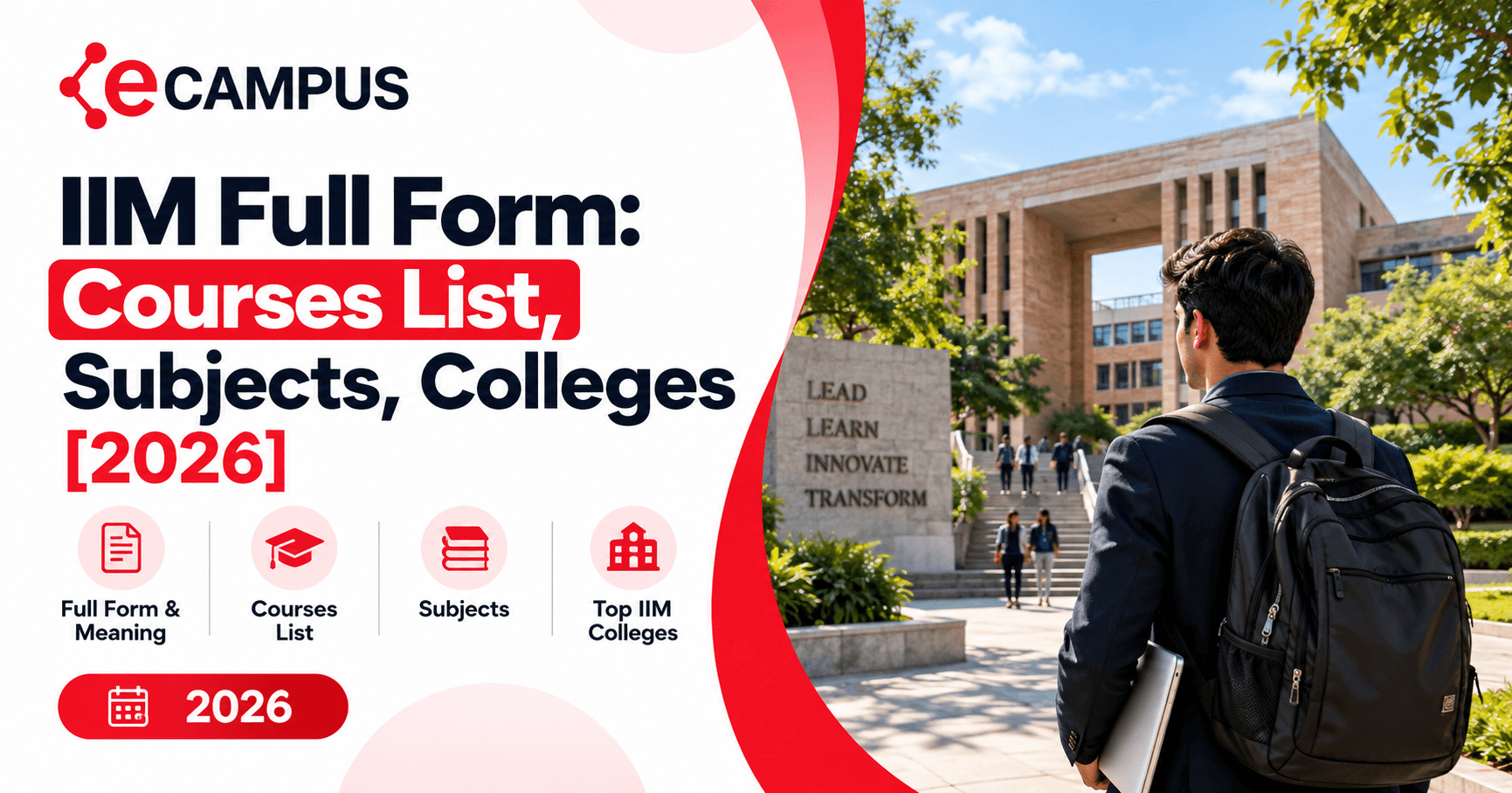
IIM Full Form: Courses List, Subjects, Colleges 2026
10 min read listen • Voice narration
IIM is one of the most recognized names in management education in India. Students, graduates, working professionals, and business aspirants often look at IIMs for MBA, executive, doctoral, and other management programmes.
In 2026, India has 22 Indian Institutes of Management, with IIM Guwahati becoming the newest IIM. These institutes offer programmes ranging from postgraduate management education to executive learning and doctoral research.
This guide explains the IIM full form, IIM courses list, subjects, colleges, admission process, eligibility, and career opportunities.
What Is the Full Form of IIM?
The full form of IIM is Indian Institute of Management.
IIMs are a group of public management institutions established to provide advanced education and research in management and related areas.
Each IIM operates as an institution of national importance under the Indian Institutes of Management Act, 2017, along with subsequent amendments.
IIMs are known for their rigorous academic curriculum, case-based learning, research, industry interaction, and management education.
How Many IIMs Are There in India in 2026?
As of 2026, there are 22 IIMs in India.
The newest addition is IIM Guwahati, which became the 22nd IIM and started its first MBA batch in 2026.
List of IIM Colleges in India 2026
No. | IIM College | Location |
|---|---|---|
1 | IIM Ahmedabad | Ahmedabad, Gujarat |
2 | IIM Bangalore | Bengaluru, Karnataka |
3 | IIM Calcutta | Kolkata, West Bengal |
4 | IIM Lucknow | Lucknow, Uttar Pradesh |
5 | IIM Indore | Indore, Madhya Pradesh |
6 | IIM Kozhikode | Kozhikode, Kerala |
7 | IIM Shillong | Shillong, Meghalaya |
8 | IIM Rohtak | Rohtak, Haryana |
9 | IIM Ranchi | Ranchi, Jharkhand |
10 | IIM Raipur | Raipur, Chhattisgarh |
11 | IIM Tiruchirappalli | Tiruchirappalli, Tamil Nadu |
12 | IIM Udaipur | Udaipur, Rajasthan |
13 | IIM Kashipur | Kashipur, Uttarakhand |
14 | IIM Nagpur | Nagpur, Maharashtra |
15 | IIM Amritsar | Amritsar, Punjab |
16 | IIM Bodh Gaya | Bodh Gaya, Bihar |
17 | IIM Jammu | Jammu, Jammu and Kashmir |
18 | IIM Sirmaur | Sirmaur, Himachal Pradesh |
19 | IIM Sambalpur | Sambalpur, Odisha |
20 | IIM Visakhapatnam | Visakhapatnam, Andhra Pradesh |
21 | IIM Mumbai | Mumbai, Maharashtra |
22 | IIM Guwahati | Guwahati, Assam |
IIM Mumbai was formerly known as the National Institute for Industrial Engineering, or NITIE, before its conversion into an IIM. IIM Guwahati is the latest institute to join the IIM system.
What Courses Do IIMs Offer?
IIMs offer much more than a traditional two-year MBA. The exact programme list differs from one institute to another.
Major categories include:
MBA and Postgraduate Management Programmes
The two-year postgraduate management programme is the most commonly associated course with IIMs.
Depending on the institute, the programme may be called:
MBA
Post Graduate Programme in Management
Post Graduate Programme
Post Graduate Programme in Management for specific sectors
For example, IIM Ahmedabad's flagship two-year PGP leads to an MBA degree.
Executive MBA Programmes
Many IIMs offer management programmes designed for experienced professionals.
Examples include one-year or executive-level programmes designed around leadership, strategy, general management, and career progression.
The names and admission requirements vary by institute.
Integrated Programme in Management
Selected IIMs offer the Integrated Programme in Management or IPM, which combines undergraduate and postgraduate management education.
These programmes are generally designed for students entering management education after Class 12.
IIM Indore, IIM Rohtak, IIM Jammu, and IIM Bodh Gaya are among the IIMs offering integrated management programmes.
PhD and Doctoral Programmes
IIMs also offer doctoral programmes for candidates interested in research and academia.
These programmes can cover areas such as management, finance, marketing, organizational behaviour, operations, economics, information systems, and strategy.
The programme may be referred to as a PhD Programme, Doctoral Programme, or Fellow Programme in Management, depending on the institute.
Executive Education and Certificate Programmes
IIMs conduct executive education programmes and management development programmes for working professionals.
These may focus on specialized areas such as leadership, business analytics, digital transformation, finance, marketing, human resources, entrepreneurship, and strategy.
IIM MBA Subjects
The exact curriculum differs between IIMs, but management students commonly study a combination of foundational, functional, analytical, and strategic subjects.
Some common MBA subjects include:
Finance and Accounting
Students may study areas such as financial reporting, corporate finance, financial markets, management accounting, investment analysis, and financial management.
Marketing
Marketing subjects can include consumer behaviour, marketing management, brand management, digital marketing, sales management, and market research.
Human Resource Management
This area can cover organizational behaviour, human resource management, talent management, leadership, employee relations, and organizational development.
Operations Management
Operations subjects generally focus on production systems, supply chains, process improvement, operations strategy, and decision-making.
Economics
Students may study microeconomics, macroeconomics, managerial economics, economic policy, and business environments.
Business Analytics
Analytics-related subjects can include statistics, data analysis, business intelligence, quantitative methods, and decision analytics.
Strategy
Strategic management helps students understand competitive strategy, corporate strategy, business models, organizational decisions, and long-term growth.
Information Technology
Depending on the programme, students may study information systems, digital transformation, technology management, and the use of technology in business.
Business Communication
Communication courses can focus on professional writing, presentations, interpersonal communication, negotiations, and managerial communication.
Example of IIM MBA Subjects
To understand the structure better, a typical management curriculum may include:
Subject Area | Example Subjects |
|---|---|
Finance | Corporate Finance, Financial Markets |
Accounting | Financial Reporting, Cost Management |
Marketing | Marketing Management, Consumer Behaviour |
HR | Human Resource Management, Organizational Behaviour |
Operations | Operations Management, Supply Chain |
Economics | Microeconomics, Macroeconomics |
Strategy | Strategic Management, Corporate Strategy |
Analytics | Quantitative Methods, Data Analysis |
Technology | Information Systems, Digital Transformation |
Communication | Business Communication, Presentation Skills |
The actual subjects, electives, and course names depend on the individual IIM and programme.
IIM Specializations
IIMs do not follow one common specialization list. Instead, students may choose electives or specialized programmes depending on the institute.
Common management areas include:
Finance
Marketing
Human Resources
Operations
Business Analytics
Strategy
Information Systems
Entrepreneurship
Economics
International Business
For example, some IIMs offer specialized management programmes in areas such as food and agribusiness, healthcare, digital business, business analytics, or human resources.
IIM Admission Process 2026
For many major two-year IIM management programmes, the Common Admission Test or CAT is the primary entrance examination for domestic applicants.
The general process involves:
Step 1: Check Eligibility
Candidates first need to check the academic qualification, minimum marks, and other conditions prescribed by the particular IIM.
Step 2: Appear for CAT
Candidates seeking admission through the CAT route need to take the Common Admission Test.
Step 3: Apply to IIMs
Candidates may need to complete institute-specific application requirements depending on the admission policy.
Step 4: Shortlisting
IIMs use their own shortlisting criteria. These can consider CAT performance, academic profile, work experience, diversity factors, and other components.
Step 5: Written Assessment or Interview
Depending on the institute and programme, shortlisted candidates may participate in a personal interview, written assessment, or another selection component.
Step 6: Final Selection
The final admission decision is based on the particular institute's published admission policy.
Not every IIM uses exactly the same selection formula.
IIM Eligibility for MBA
The basic eligibility for a two-year MBA or PGP commonly includes a bachelor's degree from a recognized institution with the minimum required marks or equivalent criteria.
However, requirements differ among IIMs.
Some programmes may also consider:
Academic performance
Work experience
CAT score
Category
Gender or academic diversity factors
Personal interview
Written assessment
Candidates should always check the individual IIM's admission policy for the specific year.
IIM Courses for Working Professionals
IIMs also offer programmes designed for experienced professionals.
Depending on the institute, these may include:
One-year MBA programmes
Executive MBA programmes
Executive postgraduate programmes
Blended management programmes
Leadership programmes
Specialized executive programmes
Management development programmes
For example, IIM Ahmedabad currently offers programmes such as MBA-PGPX for experienced professionals and a two-year blended MBA-BPGP.
The eligibility requirements can be significantly different from those for the regular two-year MBA.
IIM Courses After Class 12
Students who have completed Class 12 can explore integrated management programmes at selected IIMs.
The IPM is designed to combine undergraduate-level foundational learning with postgraduate management education.
The structure differs across institutes, but students may study subjects from mathematics, statistics, economics, humanities, communication, and management before moving into advanced management education.
Some IIMs also award a bachelor's degree at the exit point or provide a combined undergraduate and MBA pathway according to their programme rules.
IIM Course Duration
The duration depends on the type of programme.
Course Type | Typical Duration |
|---|---|
Two-Year MBA or PGP | 2 Years |
Executive MBA | 1–2 Years |
Integrated Programme in Management | 5 Years |
Doctoral Programme | Generally 4–5 Years or more |
Certificate Programmes | Varies |
Executive Education | Varies |
These are broad categories. The actual duration should be checked on the individual IIM's official programme page.
IIM Fees
IIM fees are not the same across all institutes or programmes.
Even within one institute, fees can vary depending on whether the programme is a regular MBA, executive programme, doctoral programme, or specialized management programme.
For this reason, students should compare the official fee structure of their chosen IIM and programme rather than assuming a single IIM fee applies everywhere.
Additional expenses such as accommodation, academic materials, travel, and other campus-related costs may also apply depending on the programme.
Why Do Students Choose IIMs?
IIM programmes generally combine classroom learning with practical business applications.
Depending on the programme, students may experience:
Case-based learning
Business simulations
Group projects
Industry interaction
Internships
Live projects
Research opportunities
Student clubs
Leadership activities
Alumni networking
For example, IIM Ahmedabad's MBA curriculum includes foundational subjects across accounting, finance, marketing, organizational behaviour, operations, quantitative methods, strategy, and information technology.
Career Opportunities After an IIM Course
Career opportunities depend on the programme, specialization, previous experience, skills, and individual recruitment outcomes.
MBA graduates may pursue roles such as:
Career Area | Possible Job Roles |
|---|---|
Finance | Financial Analyst, Investment Banking Associate, Finance Manager |
Marketing | Brand Manager, Marketing Manager, Product Marketing |
Consulting | Management Consultant, Business Consultant |
HR | HR Manager, Talent Management Specialist |
Operations | Operations Manager, Supply Chain Manager |
Analytics | Business Analyst, Data Analyst |
Strategy | Strategy Consultant, Business Strategy Manager |
Product | Product Manager, Product Strategy |
Sales | Sales Manager, Business Development Manager |
Entrepreneurship | Founder, Business Development Lead |
Experienced professionals pursuing executive programmes may use the learning to strengthen their existing career path or prepare for broader managerial responsibilities.
IIMs and Career Development
An IIM programme can provide academic knowledge and exposure to different business functions, but career outcomes are not determined by the institute name alone.
Employers may consider:
Academic performance + skills + experience + internships + projects + communication + leadership ability
For experienced professionals, previous industry experience can also have a major role in career progression.
IIM vs Other MBA Colleges
IIMs are a distinct group of institutions established under a central legal framework, but India also has many other universities, business schools, and management institutes offering MBA programmes.
When comparing management schools, students can examine:
Factor | What to Consider |
|---|---|
Programme | MBA, Executive MBA, Specialized MBA |
Curriculum | Subjects, electives, practical learning |
Faculty | Academic and industry expertise |
Admission | CAT or other entrance route |
Location | Campus and accessibility |
Career Support | Placement and career services |
Alumni | Industry presence and network |
Learning Format | Full-time, executive, online or blended |
Total Cost | Tuition and other expenses |
Career Goal | Finance, consulting, marketing, entrepreneurship, etc. |
The right programme depends on the student's academic background and career objective.
Is CAT Mandatory for Every IIM Course?
No.
CAT is strongly associated with admission to many flagship two-year IIM management programmes, but not every IIM programme uses CAT as its admission route.
Executive programmes may accept GMAT, GRE, institute-specific tests, or other criteria.
Integrated management programmes can have their own admission examinations, such as IPMAT or JIPMAT, depending on the institute.
Doctoral and certificate programmes also have separate admission requirements.
Therefore, candidates should check the specific programme instead of assuming that CAT is compulsory for every course offered by every IIM.
Which IIM Is the Newest in 2026?
IIM Guwahati is the newest IIM in India in 2026.
It is the 22nd IIM and is located in Assam. The institute started its first MBA batch in 2026 and is being mentored by IIM Ahmedabad during its initial development phase.
Frequently Asked Questions
1. What is the full form of IIM?
IIM stands for Indian Institute of Management. IIMs are public management institutions established under the Indian Institutes of Management Act and subsequent amendments.
2. How many IIMs are there in India in 2026?
There are 22 IIMs in India in 2026. IIM Guwahati is the newest and the 22nd IIM.
3. What courses are offered by IIMs?
IIMs offer MBA and postgraduate management programmes, executive MBA programmes, integrated management programmes, doctoral programmes, and executive education or certificate programmes. The exact courses vary by IIM.
4. What subjects are taught in an IIM MBA?
Common subjects include Finance, Accounting, Marketing, Human Resource Management, Operations, Economics, Quantitative Methods, Strategy, Business Analytics, Information Systems, and Business Communication.
5. Is CAT required for admission to IIM?
CAT is the main entrance route for many flagship two-year management programmes, but it is not mandatory for every IIM programme. Executive, doctoral, integrated, and certificate programmes may have different admission criteria.