
Physical AI vs Agentic AI: Which One Plays a Better Role?
12 min read listen • Voice narration
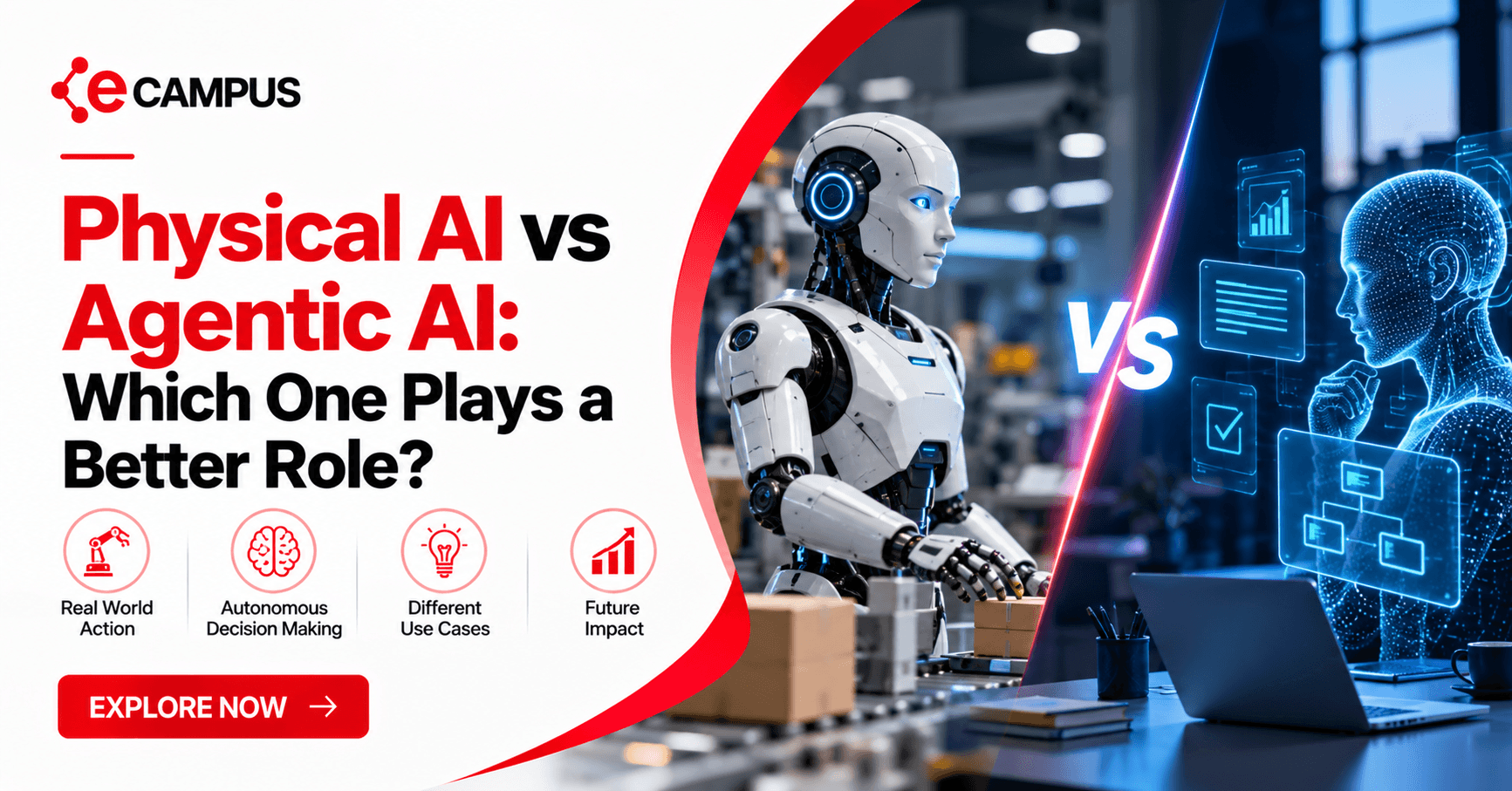
Artificial Intelligence is moving beyond simple chatbots and content-generation tools. Two major developments gaining attention are Physical AI and Agentic AI. While both involve systems that can perceive information, reason, and take action, they operate in very different environments.
Physical AI is designed to interact with the real, physical world, often through robots, autonomous vehicles, machines, and sensors. Agentic AI focuses more on digital environments, where AI agents can plan tasks, use software tools, make decisions, and complete workflows with limited human intervention.
So, which one plays a better role? The answer depends on the problem being solved. Physical AI is particularly relevant when intelligence needs to operate in the physical world, while Agentic AI is more suited to complex digital tasks and business workflows.
What Is Physical AI?
Physical AI refers to AI systems that can perceive, understand, reason about, and act within the physical environment.
Unlike software that only generates information, Physical AI can receive information from cameras, microphones, lidar, and other sensors and then translate that information into physical actions. NVIDIA describes Physical AI as enabling autonomous systems such as robots and self-driving vehicles to perceive, reason, and perform complex actions in the real world.
For example, a warehouse robot may identify a package, understand where it needs to go, navigate around obstacles, pick it up, and move it to another location.
Examples of Physical AI
Physical AI can be found in technologies such as:
Humanoid robots
Autonomous vehicles
Warehouse robots
Industrial robots
Drones
Smart manufacturing systems
Autonomous delivery systems
AI-powered machines
The key characteristic is that the AI has an embodied presence or connection to the physical environment.
What Is Agentic AI?
Agentic AI refers to AI systems that can work toward a goal with limited human supervision.
Instead of simply responding to a prompt, an AI agent can break a problem into multiple steps, decide what actions are required, use tools or APIs, evaluate results, and continue until the task is completed. IBM describes agentic AI as systems capable of autonomous, goal-driven behavior and adapting their workflow as circumstances change.
For example, an agentic system could be asked to research a market, collect information from multiple sources, organize the findings, prepare a report, and send it to a specified person.
Examples of Agentic AI
Agentic AI can be used for:
Customer support
Software development
Business research
IT automation
Data analysis
Workflow management
Financial operations
Document processing
Enterprise search
Digital assistants
The defining feature is not necessarily a physical body. It is the ability to plan and execute a sequence of actions toward a goal.
Physical AI vs Agentic AI: Key Difference
The simplest way to understand the difference is to think about where the AI acts.
Feature | Physical AI | Agentic AI |
|---|---|---|
Main Environment | Physical world | Digital environment |
Core Capability | Perceive and act in physical space | Plan and execute digital tasks |
Common Technologies | Sensors, robotics, computer vision, simulation | LLMs, APIs, tools, memory, orchestration |
Typical Output | Physical action | Digital action or completed workflow |
Examples | Robots, autonomous vehicles | AI agents, enterprise agents |
Interaction | Machines and physical surroundings | Software, data, applications and users |
Major Challenge | Safety and unpredictable environments | Reliability, security and autonomous decision-making |
The boundary is not always absolute. A sophisticated system can combine the two.
How Physical AI Works
Physical AI needs to understand an environment that can change from one moment to the next.
A typical Physical AI system involves several stages.
Perception
Sensors collect information about the surrounding environment.
A robot, for example, may use cameras and other sensors to identify objects, people, surfaces, and obstacles.
Understanding
The system interprets what it sees and relates objects to their environment.
Spatial relationships are particularly important because the AI needs to understand where things are located and how they may move.
Reasoning
The AI determines what should happen next.
A robot may need to decide how to reach an object without colliding with another machine.
Action
The system sends commands to motors, actuators, or other physical components.
Adaptation
Real environments are unpredictable. Objects can move, people can enter a workspace, or conditions can change.
Physical AI therefore needs to adapt to new situations instead of following one rigid sequence.
Simulation and synthetic data are also increasingly important for training Physical AI systems safely before deployment in the real world.
How Agentic AI Works
Agentic AI generally follows a continuous digital decision-making loop.
Understanding the Goal
The system receives an objective from a user or another application.
Planning
The agent decides what steps may be required to achieve the objective.
Tool Use
It can call APIs, search systems, databases, software applications, or other tools.
Execution
The agent performs the planned actions.
Evaluation
It reviews the outcome and determines whether another step is needed.
Adaptation
If the original approach does not work, the agent can adjust its strategy.
This ability to operate through multiple steps is one of the main differences between agentic systems and traditional chat-based AI.
Physical AI Use Cases
Physical AI becomes especially relevant when AI needs to interact directly with people, objects, or machinery.
Manufacturing
Robots can inspect products, move components, perform assembly tasks, and adapt to production environments.
Warehousing
Autonomous systems can transport goods, identify packages, navigate warehouse spaces, and coordinate physical tasks.
Healthcare
Physical AI can support certain forms of robotic assistance, medical device automation, and rehabilitation technology, subject to appropriate safety and regulatory requirements.
Transportation
Autonomous driving systems use sensors, perception, planning, and control to navigate physical environments.
Agriculture
AI-enabled machinery can monitor fields, identify conditions, and automate selected agricultural operations.
Domestic Robotics
Home robots may eventually handle more complex physical tasks such as cleaning, carrying objects, or assisting people with everyday activities.
Agentic AI Use Cases
Agentic AI is particularly useful when the work takes place inside software systems.
Business Operations
Agents can handle repetitive workflows involving documents, approvals, data retrieval, and task coordination.
Customer Service
An agent can understand a customer request, retrieve account information, interact with internal systems, and complete certain service tasks.
Software Development
Agents can help analyze requirements, write code, run tests, identify errors, and revise implementation.
Research
An agent can search multiple information sources, organize findings, compare data, and prepare structured outputs.
Marketing
Agents can assist with campaign planning, content workflows, audience analysis, and reporting.
IT Operations
Agentic systems can monitor events, investigate issues, recommend actions, and automate selected operational tasks.
IBM's 2026 AI roadmap highlights the growing use of multi-agent systems for software that can plan, act, and adapt in real time, while also noting that deployment remains technically challenging.
Physical AI vs Agentic AI in Business
The two technologies can solve very different business problems.
Consider a manufacturing company.
A Physical AI system could control robots that move materials across a factory.
An Agentic AI system could monitor production data, review inventory information, communicate with suppliers, and coordinate digital workflows.
The first works mainly with the physical operation.
The second works mainly with the digital operation.
This distinction helps businesses decide where each technology fits.
Which One Is Better for Automation?
Both can support automation, but their automation targets are different.
Agentic AI is well suited to automating knowledge work and digital processes. It can handle multi-step tasks that previously required employees to move between different software systems.
Physical AI is suited to automating physical tasks, particularly where robots or autonomous machines are required.
For example:
Processing an insurance claim is a potential Agentic AI use case.
Moving products through a warehouse is a potential Physical AI use case.
Therefore, the type of task matters more than the label attached to the technology.
Physical AI vs Agentic AI: Advantages
Physical AI Advantages
Physical AI can bring intelligence directly into physical operations.
It can enable:
Real-world perception
Machine autonomy
Robotic adaptability
Automated physical work
Operation in dynamic environments
It can also reduce the need for rigid programming in some robotic applications by allowing machines to respond to changing surroundings.
Agentic AI Advantages
Agentic AI can automate workflows that involve multiple software systems.
Its capabilities can include:
Goal-oriented execution
Multi-step planning
Tool use
Workflow automation
Real-time adaptation
Coordination between multiple agents
These capabilities make agentic systems relevant to increasingly complex enterprise processes.
Challenges of Physical AI
Physical AI presents significant engineering challenges.
Safety
A system operating around humans needs reliable perception and safe decision-making.
Hardware Costs
Robots, sensors, processors, and other physical infrastructure can require substantial investment.
Real-World Uncertainty
The physical environment cannot always be predicted.
Training
Physical AI often requires large amounts of simulation, sensor data, and real-world training.
Maintenance
Hardware requires servicing, calibration, and physical maintenance.
These factors can make Physical AI more complex to deploy than software-only AI.
Challenges of Agentic AI
Agentic AI also brings important challenges.
Reliability
An agent may make incorrect decisions or choose an unsuitable tool.
Security
An autonomous system with access to business tools can create new security risks if permissions are not controlled carefully.
Monitoring
Organizations need ways to track what agents are doing and why.
Cost
Complex workflows can require substantial model usage, tool calls, and infrastructure.
Governance
Businesses need clear policies around authorization, data access, auditing, and human oversight.
IBM's current 2026 AI roadmap describes the agent landscape as still evolving and highlights security and deployment challenges associated with autonomous systems.
Can Physical AI and Agentic AI Work Together?
Yes. In fact, combining them can create more capable autonomous systems.
Imagine a smart warehouse.
An Agentic AI system could receive an order, determine which products are needed, coordinate inventory, and create a task sequence.
A Physical AI system could then control robots that retrieve those products and move them to the dispatch area.
In this setup:
Agentic AI handles planning and digital coordination.
Physical AI handles perception and physical execution.
The two can therefore complement each other rather than compete directly.
Physical AI vs Agentic AI for the Future of Work
Both technologies are likely to influence the future of work, but in different ways.
Agentic AI is closely connected to the automation of knowledge-based workflows.
Physical AI is connected to the automation of physical work and machine interaction.
This means professionals in different industries may encounter the technologies in different forms.
For example, a software professional may work more closely with agentic coding systems, while an industrial engineer may work more closely with robotic Physical AI systems.
Physical AI vs Agentic AI: Skills Professionals Need
As these technologies develop, professionals can benefit from understanding the underlying concepts.
Skills for Physical AI
Relevant areas include:
Robotics
Computer vision
Machine learning
Sensor technologies
Control systems
Simulation
Embedded systems
Mechatronics
Skills for Agentic AI
Relevant areas include:
Large language models
AI agents
Prompt and workflow design
APIs
Python and software development
Data engineering
Retrieval systems
AI orchestration
AI governance
Professionals working at the intersection of both fields may also need cloud computing, edge computing, systems integration, and cybersecurity knowledge.
Physical AI vs Agentic AI: Which Has a Better Role?
There is no universal winner because the two technologies solve different categories of problems.
Physical AI has a stronger role when the challenge involves the physical world, such as robotics, autonomous machines, manufacturing, logistics, and transportation.
Agentic AI has a stronger role when the challenge involves digital work, such as research, software operations, customer support, business workflows, and enterprise automation.
The distinction becomes even less clear when the two systems are connected.
A future autonomous factory, for instance, could use Agentic AI to make high-level operational decisions while Physical AI controls robots and machines on the factory floor.
Physical AI and Agentic AI in 2026
In 2026, both areas are developing rapidly.
Agentic AI research and enterprise applications are expanding around multi-agent orchestration, tool use, enterprise search, and autonomous workflows. IBM's developer updates from September 2026 show continued development around agentic control planes, observability, governance, and multi-agent RAG workflows.
Physical AI development is also advancing through robotics simulation, synthetic data, world models, sensor integration, and sim-to-real training. NVIDIA's current Physical AI materials describe workflows that train systems in simulation before deploying them onto physical robots.
These developments suggest that the distinction between digital intelligence and physical intelligence may become increasingly interconnected.
How Businesses Can Decide Which Technology to Explore
Businesses should begin with the operational problem rather than the technology label.
Ask:
Is the task digital or physical?
Does it require software tools or physical machines?
How much autonomy is appropriate?
What level of human oversight is required?
What are the safety and security risks?
What infrastructure already exists?
A company automating document workflows may start with Agentic AI.
A company automating warehouse movement may investigate Physical AI.
A company building an autonomous facility may eventually need both.
Physical AI vs Agentic AI: Future Possibilities
The long-term opportunity may not be about choosing one technology over the other.
Instead, AI systems may increasingly combine:
Reasoning
Planning
Perception
Memory
Tool use
Robotic control
Real-world feedback
This could create systems capable of understanding a goal, planning how to achieve it, and coordinating both digital and physical actions.
For example, a logistics system could receive a customer order through an agentic interface, optimize the delivery plan, instruct warehouse robots to prepare the package, and coordinate autonomous transport.
That scenario requires both digital reasoning and physical execution.
Conclusion
Physical AI and Agentic AI serve different roles, so neither can be considered universally better. Physical AI is focused on intelligence that can perceive and act in the real world through robots, autonomous machines, and connected physical systems. Agentic AI focuses on autonomous digital action, allowing AI systems to plan tasks, use tools, and execute complex workflows.
For businesses and professionals, the choice depends mainly on the problem being solved. Physical AI is highly relevant to robotics, manufacturing, transportation, and other physical operations, while Agentic AI is particularly relevant to software, research, customer service, enterprise automation, and digital workflows.
The most significant development may come from combining both. Agentic AI can provide planning and coordination, while Physical AI can turn those decisions into real-world actions.
Physical AI vs Agentic AI FAQs
1. What is the main difference between Physical AI and Agentic AI?
Physical AI is designed to perceive and interact with the physical world, often through robots and autonomous machines. Agentic AI is designed to pursue goals and execute multi-step tasks mainly through digital tools, applications, and systems.
2. Is Physical AI better than Agentic AI?
Neither is universally better. Physical AI is more relevant to physical-world tasks, while Agentic AI is more relevant to complex digital workflows. The appropriate technology depends on the use case.
3. Can Physical AI and Agentic AI work together?
Yes. Agentic AI can handle planning, coordination, and decision-making while Physical AI can execute actions through robots or autonomous machines.
4. Which industries can benefit from Physical AI?
Industries such as manufacturing, logistics, transportation, agriculture, robotics, and some healthcare applications can use Physical AI for physical-world tasks.
5. Which is more useful for business automation: Physical AI or Agentic AI?
Agentic AI is particularly applicable to digital business workflows, while Physical AI is applicable to physical operations. Businesses can use either or both depending on what they are trying to automate.